
ELLA changelog
A smarter, more transparent AI assistant
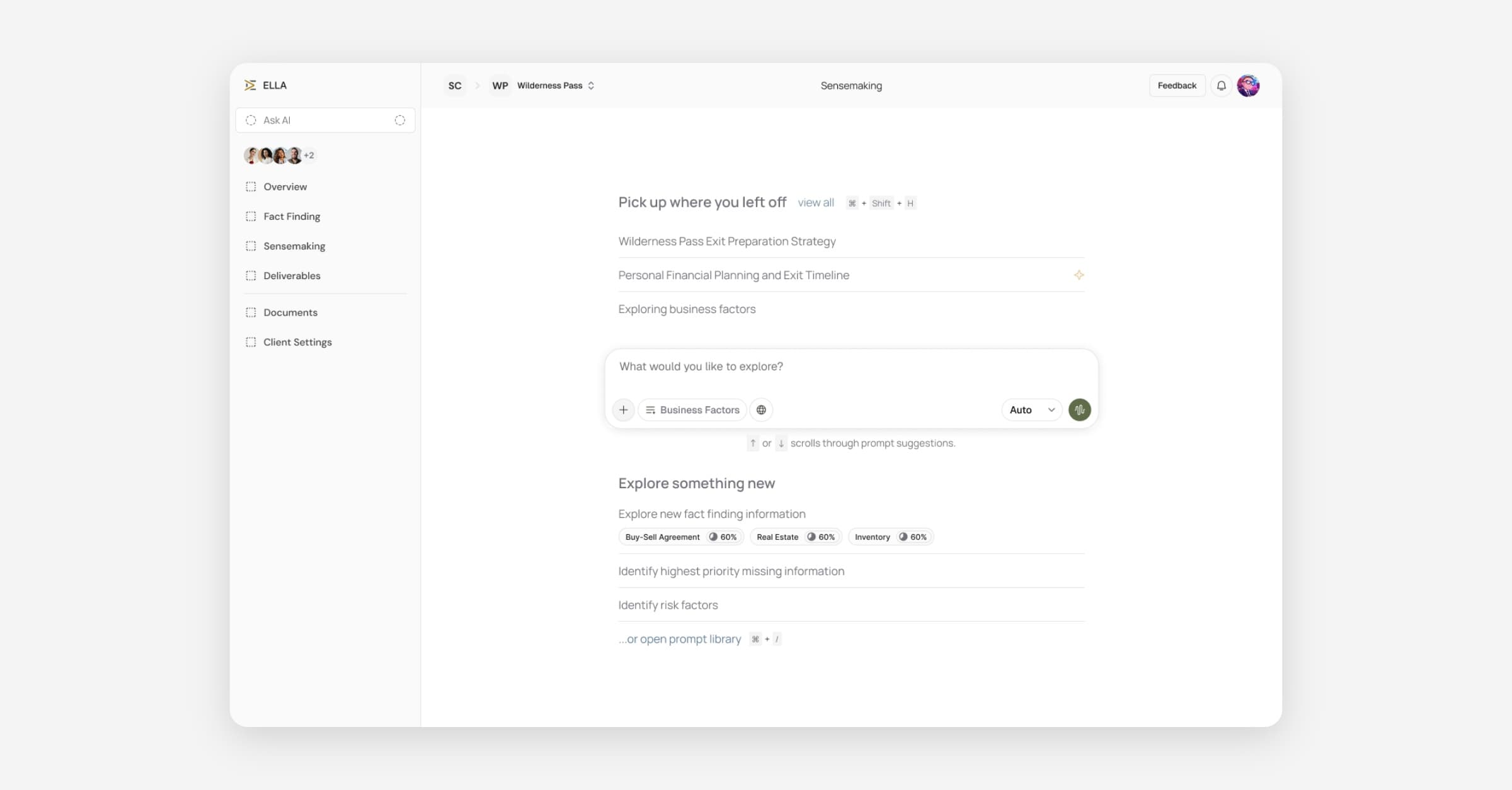
We rebuilt ELLA’s AI from the ground up. It now shows its reasoning, cites its sources, and adapts to how you work with each client.
See how ELLA thinks. As ELLA works through a question, you’ll watch it move step-by-step — loading the right expertise, checking your client’s documented facts, and drafting its response. No more staring at a blank “thinking…” spinner.
Every answer, backed by evidence. ELLA now attaches its sources to each response, so you can click straight through to the document and passage a conclusion came from. Trust, verified.
Fact-finding inline with your chats. When ELLA finds answers in your documents, it proposes them as reviewable cards — accept, skip, or refine before anything is saved. Nothing is written without your confirmation.
Three ways to tailor ELLA to each engagement:
Client Memory: Curate the durable facts ELLA should always keep in mind for a client. Edit it anytime in Client Settings; it carries across every conversation.
Domain guides: ELLA automatically pulls in the right specialized skills (valuation prep, exit planning, and more) based on what you’re asking.
Focus the analysis: Select a group of business factors and ELLA scopes its fact-finding and recommendations to exactly those.
Rethinking your Sensemaking start screen
Along with behind-the-scenes changes, we’ve launched a redesigned home for Sensemaking. The screen you start most of your work from is now built around your momentum:
Pick up where you left off: recent conversations sit right at the top, one click (or ⌘⇧H) from resuming.
A calmer, more capable prompt box: ask anything, scope it to specific Business Factors, switch models, and scroll prompt suggestions with the arrow keys.
Explore something new: ELLA points you to your next best moves: fact-finding areas with live completion progress (Buy-Sell Agreement, Real Estate, Inventory…), the highest-priority gaps, and key risk factors.
A prompt library at your fingertips: open a full catalog of ready-to-run prompts anytime with ⌘/.
Under the hood
Very little of those changes came from tuning prompts. It came from replacing the assistant’s foundation.
ELLA’s AI originally ran on a general-purpose stack — LangChain and LangGraph, stitched together with a good deal of hand-rolled machinery for memory, safety, and multi-step reasoning. It worked, but every new capability meant building the scaffolding for it ourselves. We’ve moved to Mastra, upon which we’ve built a purpose-built agent framework, and rewrote the assistant to be TypeScript-native and run inside the same environment as the rest of the ELLA application. Three things changed for the better.
It behaves like an agent first, not just a chatbot that can use tools.The assistant reasons in explicit steps and takes actions — loading skills, retrieving evidence, proposing writes — with the ability to pause mid-task and hand control back to you. It also means we’ve been able to deepen how and when it runs safety checks to screen for sensitive personal data and prompt manipulation, enhancing trust and our principle of “Do Right” even further.
It remembers the right things, at the right scope. ELLA keeps a durable memory for each client engagement that persists across conversations — and that you can read and edit directly. As a discussion runs long, it compresses earlier context in the background rather than forgetting where it started or grinding slower with every turn. Memory is scoped per engagement, so one client’s context never bleeds into another’s.
It’s faster and steadier. Running inside the same environment as the rest of the app removes a network round-trip that used to sit on every request. Plus, responses now stream to you token by token as they’re generated so you see progress the moment it starts, instead of waiting on a finished block of text.
The connective tissue underneath all of this is that ELLA’s assistant now shares the same types, data models, and security rules as the rest of the platform, end to end.
That’s what let us ship reasoning transparency, safer actions, and durable memory together — as one coherent system — rather than one bolt-on at a time.